Summerland Fire Today: British Columbia Wildfire Forces More Than 20,000 to Evacuate as Bald Range Fire Races Toward Okanagan Communities
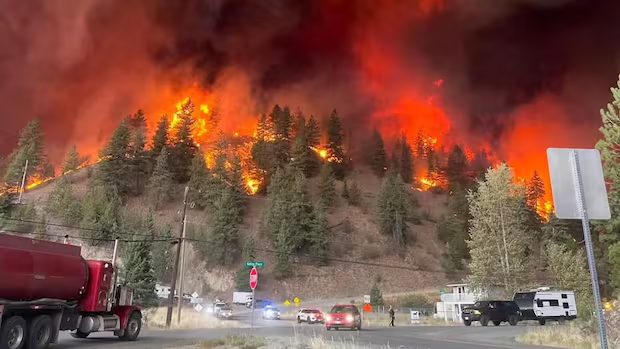
When you think of the Okanagan Valley, your mind immediately goes to rolling vineyards, sparkling lakes, and perfect summer afternoons. But today, that idyllic image has been replaced by apocalyptic skies and sheer panic. The Summerland fire today, officially known as the Bald Range wildfire, has triggered one of the most intense and rapid emergency responses in British Columbia’s history. This fast-moving British Columbia wildfire forces more than 20,000 to evacuate as the Bald Range fire races toward Okanagan communities, destroying property, threatening lives, and turning a summer paradise into a disaster zone.
If you are just tuning in, the sheer scale of this emergency is hard to wrap your head around. Entire towns have been ordered to leave. Highways are shut down. The sky is an eerie, choking orange. Premier David Eby has declared a provincial state of emergency, describing the fire’s explosive growth as being “like a bomb going off.” But how did we get here? How did a small spark west of Summerland escalate into a 9,500-hectare monster overnight?
In this exhaustive deep-dive, we are going to look at every single angle of this unprecedented disaster. We will walk through the exact timeline of the fire’s eruption and the logistical nightmare of evacuating over 20,000 people in the dark. We will analyze the front-line firefighting strategies, the devastating economic blow to Canada’s wine country, and the psychological toll on the community. Furthermore, we will take a deep, analytical turn into the realms of legal philosophy, examining how massive crises like this trigger complex webs of liability, accountability, and media scrutiny. We will even draw fascinating, albeit surprising, parallels to high-profile public accountability cases—like those of Harvey Weinstein and Rudy Giuliani—to understand how the court of public opinion and legal liability intersect during a massive public crisis.
Grab a cup of coffee and settle in. This is the most comprehensive guide to understanding the Bald Range fire, the state of the Okanagan, and what this disaster means for the future of British Columbia.
The Eruption: How the Bald Range Fire Exploded Overnight
To understand the absolute chaos currently unfolding in the Okanagan, you have to look at how quickly this beast grew. The Bald Range fire didn’t just start; it erupted. First detected around 5:30 p.m. on Friday, August 7, 2026, it began as an eight-hectare blaze west of Summerland, near the Princeton-Summerland Road and the historic Kettle Valley Railway (KVR) Trail. At first, it seemed like a standard late-summer flare-up. But the conditions were primed for a catastrophe.
British Columbia has been baking under an intense heat wave, accompanied by prolonged drought conditions that have left the region’s forests bone-dry. The relative humidity was practically nonexistent. When the fire sparked, it found an unlimited supply of volatile, parched fuel. Within mere hours, what started as a localized brush fire transformed into a terrifying crown fire.
Firefighters use the terms “Category 5” and “Category 6” to describe fires of this magnitude. In plain English, that means the fire isn’t just burning along the ground; it has climbed into the canopy and is racing across the tops of the trees. When a fire candles like this, it creates its own terrifying weather system. Updrafts of intense heat cause pyrocumulonimbus clouds to form, which can actually generate lightning strikes ahead of the fire, igniting new blazes and making containment virtually impossible.
The wind became the ultimate enemy. Gusts began carrying burning embers up to a full kilometer ahead of the main fire front. These airborne firebrands landed on rooftops, dry lawns, and neighboring forests, starting spot fires that quickly merged into a massive wall of flame. By Saturday morning, the fire had exploded to over 9,500 hectares (roughly 23,500 acres). The 15-kilometer buffer between the ignition point and the community of Summerland vanished in a matter of hours.
Witnesses described the scene as surreal and horrifying. Huge plumes of thick, black smoke blotted out the sun, and the roar of the fire sounded like a freight train bearing down on the valley. People who had gone to bed thinking the fire was safely distant were jolted awake by emergency alerts screaming on their phones. The speed of the Bald Range fire’s advance caught everyone off guard, leaving no time for hesitation. It was a perfect storm of geography, climate, and bad luck, setting the stage for one of the most dramatic mass evacuations British Columbia has ever seen.
Unprecedented Evacuations: Relocating 20,000 Okanagan Residents
Evacuating a single neighborhood is a logistical challenge. Evacuating multiple towns simultaneously while a wall of fire breathes down your neck is a nightmare of epic proportions. As the Bald Range fire surged eastward toward Okanagan Lake, officials were forced to make the hardest call an emergency management team can make: ordering the immediate evacuation of more than 20,000 residents.
The entire District of Summerland, home to approximately 12,000 people, was placed under a mandatory evacuation order just after midnight. Imagine the scene. It is pitch black outside, but the horizon is glowing an angry, violent red. Sirens are wailing. Your phone is buzzing with emergency broadcast alerts telling you to leave immediately. You have minutes to grab your pets, essential documents, maybe a change of clothes, and get out. There is no time to pack family heirlooms. There is no time to secure your property. You just have to run.
Shortly after Summerland’s order, the evacuation zone expanded to include an additional 8,000 residents in and around Peachland. Neighborhoods in the Peachland watershed, Brenda Mines area, and Lower Princeton were all told to flee. The sheer volume of vehicles hitting the roads at the exact same time created instant bottlenecks.
Highway 97, the vital artery connecting the Okanagan communities, became a scene of chaotic desperation. The highway had to be closed in both directions between Peachland and the Pyramid Picnic Area just south of Summerland because the fire had advanced so close to the roadway that the smoke reduced visibility to zero. With the main highway compromised, residents had to rely on backroads and designated detour routes, which quickly became clogged with frightened evacuees.
Adding to the complexity was the rescue of people who had been trapped. The fire moved so aggressively that it actually cut off escape routes for several individuals before they could get out. Central Okanagan Search and Rescue, along with the BC Wildfire Service, had to initiate heart-stopping rescue operations. Helicopters that were originally tasked with dropping water on the flames had to be urgently diverted to pluck dozens of trapped residents to safety. Forests Minister Ravi Parmar confirmed that 18 firefighting aircraft were repurposed specifically for these daring aerial rescues. Had it not been for the quick thinking of these pilots, the loss of life would have been catastrophic.
Emergency Operations Centres (EOCs) were rapidly set up in neighboring cities like Kelowna and Penticton, but they were quickly overwhelmed. Reception centers scrambled to process thousands of terrified families, offering cots, food, and emotional support. The evacuation also posed massive challenges for the region’s agricultural community. The Okanagan is farm country. Evacuating horses, cattle, and other livestock in the middle of the night requires trailers and time—time that many simply didn’t have. Heartbreakingly, many farmers were forced to leave their animals behind, opening gates in the desperate hope that the livestock could outrun the flames.
The Frontlines: British Columbia’s State of Emergency and Firefighting Strategy
When a disaster of this magnitude strikes, the government response has to be swift and overwhelming. On Saturday afternoon, Premier David Eby officially declared a provincial state of emergency. This isn’t just a symbolic gesture; declaring a state of emergency gives the government sweeping legal powers to commandeer resources, control travel, and access federal funding without the usual bureaucratic red tape.
The firefighting strategy deployed against the Bald Range fire has been a masterclass in crisis management, despite the impossible odds. Currently, there are about 1,500 firefighters battling blazes across the province, with a massive concentration of resources funneled directly into the Summerland and Peachland areas. But how do you actually fight a fire that is generating its own weather?
The short answer is: you can’t stop it directly, so you try to steer it. Ground crews simply cannot stand in front of a Category 6 crown fire; it is a death sentence. Instead, the strategy relies heavily on structural protection and aerial bombardment.
In the sky, a fleet of helicopters and fixed-wing airtankers are flying non-stop missions. Airtankers are dropping long lines of red fire retardant along the ridges, attempting to paint a chemical box around the fire’s perimeter to slow its advance. Meanwhile, skimmer aircraft are diving down into Okanagan Lake, scooping up thousands of liters of water in seconds, and dropping it directly onto the advancing flames. However, the thick smoke has severely hampered these aerial operations. Pilots cannot drop retardant if they cannot see the terrain, and the heavy smoke inversion layer has grounded flights during critical windows of the battle.
On the ground, structural protection units (SPUs) are the unsung heroes. These specialized teams rush into evacuated neighborhoods and set up massive sprinkler systems on the roofs of homes, schools, and businesses. They deploy heavy-duty hoses and high-volume pumps hooked up to municipal water supplies or drafting from swimming pools. By soaking the properties, they create a damp micro-climate that makes it incredibly difficult for airborne embers to ignite the structures.
Behind the scenes, incident commanders are operating out of mobile command centers, staring at satellite imagery, thermal maps, and real-time weather data. They are playing a high-stakes game of chess against Mother Nature. They map out containment lines, coordinate controlled burns to eliminate fuel ahead of the main fire, and manage the safety of hundreds of personnel working in extremely hazardous conditions. It is a grueling, exhausting, and dangerous job, and the men and women on the fireline are pushing themselves to the absolute limit.
Economic Shockwaves: The Impact on Okanagan’s Wine Country and Tourism
While the immediate focus is rightfully on saving lives and homes, the long-term reality is beginning to dawn on the residents of the Okanagan. This fire is going to leave a massive economic scar on the region. The Okanagan Valley is Canada’s second-largest wine-producing area, and it is entirely dependent on agriculture and summer tourism. The Bald Range fire couldn’t have hit at a worse time.
August is peak tourist season. Hotels, short-term rentals, restaurants, and tour companies rely on the influx of summer visitors to sustain their businesses for the entire year. With massive evacuation orders in place and the skies choked with toxic smoke, tourism has evaporated overnight. Bookings are being canceled en masse. The highways are closed to non-essential travel. The vibrant, bustling summer economy has been brought to a screeching, devastating halt.
But the most heartbreaking impact will be felt in the vineyards. Summerland and the surrounding areas are home to dozens of world-class wineries. Even if the flames do not physically burn the grapevines, the smoke will. When vineyards are blanketed in thick wildfire smoke during the critical ripening phase of the grapes, a phenomenon known as “smoke taint” occurs.
Volatile phenols in the smoke, specifically compounds like guaiacol and 4-methylguaiacol, permeate the grape skins. When these grapes are fermented into wine, those compounds bind with sugars and release a distinctly unpleasant flavor profile. Winemakers describe smoke-tainted wine as tasting like a wet ashtray, burnt rubber, or campfire ashes. It completely ruins the vintage.
For the wineries in Summerland and Peachland, the 2026 harvest is in serious jeopardy. If the smoke lingers, entire crops may have to be dumped. Wineries operate on thin margins, and losing an entire year’s worth of product can force small, family-owned vineyards into bankruptcy. Furthermore, farm infrastructure is at risk. Irrigation lines, trellising systems, and expensive harvesting equipment left behind during the evacuation are completely vulnerable to the flames. Mayor Doug Holmes has already noted that a lot of farms have been affected, and the community is bracing for the worst. The economic ripple effects of the Bald Range fire will be felt for years, long after the last embers are extinguished.
Legal Philosophy in Crisis: Accountability, Media Scrutiny, and Notable Precedents
When a massive disaster strikes, the immediate aftermath is characterized by survival, shock, and grief. But once the smoke clears—literally and figuratively—the public demands answers. Who is to blame? Could this have been prevented? This transition from grief to anger opens the door to complex legal battles, introducing fundamental questions of legal philosophy, corporate liability, and public accountability.
Wildfires are not always just acts of God. Often, they are the result of human negligence, utility failures, or poor forest management. As we watch the Bald Range fire devastate the Okanagan, it is vital to understand the intricate web of liability that follows such a catastrophe.
The Court of Public Opinion vs. Legal Reality
In modern crises, legal philosophy deeply intersects with media dynamics. The law operates on the principles of evidence, due process, and the slow, methodical establishment of a “duty of care.” Did a utility company fail to clear brush away from a powerline? Did the province fail to allocate enough funds for preventative prescribed burns? Proving negligence in a court of law takes years.
However, the court of public opinion operates at the speed of social media. The moment a fire starts, the public and the media begin assigning blame. This creates an intense pressure cooker for governments and corporations. Legal philosophy dictates that justice must be blind and impartial, but in reality, massive public outrage often forces rapid legal settlements, policy overhauls, and the immediate resignation of officials. The optics of a disaster are just as legally significant as the actual facts on the ground.
High-Profile Liability Parallels: What Harvey Weinstein and Rudy Giuliani Teach Us About Crisis Scrutiny
At first glance, connecting massive natural disasters to high-profile public scandals like those of Harvey Weinstein or Rudy Giuliani might seem bizarre. But from a lens of legal philosophy, crisis media presence, and institutional liability, the parallels are incredibly revealing. Both of these cases represent watershed moments in how the law, the media, and public accountability interact—principles that apply directly to mass tort litigation following natural disasters.
Take the case of Harvey Weinstein. Before his massive downfall, the legal framework surrounding workplace liability, non-disclosure agreements (NDAs), and corporate complicity heavily favored powerful institutions. Weinstein’s actions were shielded by a legal ecosystem designed to suppress public outcry. But when the media broke the story, the sheer volume of public horror completely shattered that legal shield. The resulting public scrutiny forced a fundamental shift in legal philosophy. It established that no corporation, no matter how powerful or legally insulated, can survive when its actions directly threaten public safety and morality.
Similarly, when massive utility companies are found responsible for sparking catastrophic wildfires (as we have seen in California with PG&E), they initially hide behind complex legal defenses and regulatory loopholes. But just like in the Weinstein case, the catastrophic scale of human suffering combined with relentless media exposure destroys their corporate veil. The legal system adapts to the public’s demand for justice, resulting in massive class-action lawsuits, forced bankruptcies, and sweeping legislative changes that prioritize public safety over corporate protection.
Now consider Rudy Giuliani and his recent defamation lawsuits. Giuliani’s legal ruin was brought about by his reckless dissemination of unverified claims and his fundamental misunderstanding of the boundaries of free speech versus actionable harm. The legal philosophy underlying his massive civil judgments is simple: words and actions have profound, tangible consequences, and creating a public crisis through negligence or malice carries massive financial liability.
How does this relate to the Summerland fire? It comes down to crisis communication, emergency management, and institutional responsibility. If an investigation reveals that a corporation acted recklessly—perhaps ignoring warnings about aging infrastructure in the Bald Range area—or if government officials spread misinformation or delayed life-saving emergency alerts, they will face the same ruthless legal and financial reckoning. The Giuliani precedent serves as a modern warning to all institutions managing a public crisis: in the age of hyper-media scrutiny, gross negligence and the mishandling of public safety will be punished with absolute severity in civil courts.
Corporate Negligence and Wildfire Tort Law
If a human element is found in the ignition of the Bald Range fire, we will see the activation of Wildfire Tort Law. This involves massive class-action lawsuits where thousands of displaced residents, ruined business owners, and local municipalities sue for damages.
In these legal battles, the plaintiffs must prove that the defendant owed a duty of care, breached that duty, and directly caused the destruction. For a utility company, this means proving they failed to maintain their grid against known fire risks. The legal philosophy here hinges on “foreseeability.” Because the heat dome and drought conditions in British Columbia were heavily documented and widely reported, any failure to adapt to these extreme conditions is viewed not as a simple accident, but as gross negligence. The financial stakes are staggering, often running into the billions, proving that environmental disasters are as much a legal and economic crisis as they are a physical one.
Media Presence and the Psychology of Disaster Reporting
We cannot discuss the Summerland fire without addressing how we are consuming it. The media presence during this wildfire has been overwhelming, immediate, and deeply psychological. We are no longer waiting for the evening news to tell us what happened; we are watching the disaster unfold in real-time on our smartphones.
Social media platforms like X (formerly Twitter), TikTok, and Facebook have become critical lifelines. Residents are posting videos of their midnight escapes, sharing dashcam footage of flames licking the sides of Highway 97, and crowdsourcing information on available shelters and safe routes. The democratization of news allows for rapid information sharing that traditional authorities sometimes struggle to match.
However, this hyper-connected media presence has a dark side. The speed of information also means the speed of misinformation. Rumors about trapped families, destroyed landmarks, or supposed arsonists can spread like wildfire themselves, causing unnecessary panic and diverting crucial emergency resources. Emergency management teams in the Okanagan have had to dedicate specific personnel just to monitor social media and debunk false claims in real-time.
Then there is the psychological toll. “Doomscrolling” is a very real phenomenon during a localized disaster. For the 20,000 evacuees sitting in cots at reception centers, their phones are their only connection to their homes. They sit for hours, refreshing feeds, analyzing low-resolution photos of smoke plumes, trying to geolocate the flames to see if their house is still standing. The constant barrage of apocalyptic imagery creates acute trauma and anxiety. The media’s responsibility in these moments is massive. Reporters and news outlets must balance the need to convey the severity of the crisis with the moral obligation to avoid sensationalism that induces panic. The narrative shapes the community’s emotional resilience.
Historical Context: Is the 2026 British Columbia Wildfire Season the New Normal?
As we watch the Bald Range fire devour the hillsides of the Okanagan, a chilling question hangs in the air: Is this the new normal? To answer that, we have to look at the historical context of British Columbia’s relationship with wildfires.
For decades, fire has been a natural and necessary part of the B.C. ecosystem. Historically, low-intensity fires would sweep through forests, clearing out dead underbrush, returning nutrients to the soil, and opening the canopy for new growth. Indigenous peoples successfully used controlled burns for millennia to manage the land.
However, over the last century, modern forest management adopted a strict fire-suppression policy. Every fire was put out as quickly as possible. While this protected timber assets in the short term, it created a massive, unnatural buildup of fuel on the forest floor. When you combine this century of fuel accumulation with the undeniable impacts of climate change—longer, hotter summers, reduced snowpack, and severe multi-year droughts—you get the recipe for the explosive mega-fires we are seeing today.
We only have to look back to the catastrophic 2023 British Columbia wildfire season to see the pattern. That year, massive fires decimated areas around Kelowna, Shuswap, and the Cariboo region. Thousands were evacuated, and hundreds of homes were lost. Now, just three years later, in 2026, we are watching history repeat itself with terrifying precision.
The Bald Range fire is not an anomaly; it is a symptom of a fundamentally altered climate and ecosystem. The frequency of these extreme events is accelerating. What used to be a “once-in-a-century” fire is now happening every few years. This grim reality requires a total paradigm shift in how we build and defend our communities. We can no longer just react to fires; we have to proactively adapt to living in a fire-dominated landscape. This means rethinking urban planning, enforcing strict FireSmart building codes, retrofitting existing homes with fire-resistant materials, and aggressively returning to the practice of prescribed cultural burns to manage the forest fuels before the summer heat arrives.
Community Resilience: How Summerland and Peachland Are Rebuilding Hope
Despite the overwhelming destruction, the terrifying evacuations, and the looming economic hardships, the defining narrative of the Summerland fire will ultimately be one of community resilience. The people of the Okanagan Valley are tough. They are deeply connected to their land, their businesses, and to one another.
In the darkest hours of the Friday night evacuation, the true spirit of the community shone through. Strangers knocked on doors to make sure their elderly neighbors were awake. People with horse trailers drove directly toward the danger to help farmers evacuate their livestock. Volunteers flooded the emergency reception centers in Penticton and Kelowna, bringing blankets, hot coffee, and dog food, working around the clock to comfort terrified families who had just lost everything.
Local businesses that were outside the evacuation zones immediately stepped up. Restaurants donated hot meals to the exhausted firefighters and displaced residents. Hotels waived their fees and opened their doors to evacuees and their pets. It is in these moments of profound crisis that the superficial divisions of daily life wash away, revealing a deep, unbreakable human solidarity.
The road ahead for Summerland and Peachland is going to be incredibly difficult. When the smoke finally clears and the evacuation orders are lifted, residents will return to a scarred landscape. Some will return to find their homes reduced to white ash and twisted metal. Wineries will have to navigate the heartbreak of a lost vintage. The trauma of the evacuation will linger in the minds of the children and adults alike.
But they will not face it alone. British Columbians have a proven track record of rallying behind their own. Provincial and federal relief funds will eventually flow, charitable organizations will mobilize, and neighbors will help neighbors sift through the ashes and swing the first hammers of reconstruction. The forests of the Bald Range will eventually green again, the vineyards will recover and produce new vintages, and the communities of Summerland and Peachland will rebuild, stronger and more resilient than ever before.
Frequently Asked Questions (FAQ)
To provide maximum clarity during this rapidly evolving situation, we have compiled the most urgent questions surrounding the Summerland and Bald Range fire.
What is the current size of the Bald Range fire? As of the latest reports, the Bald Range fire has grown to approximately 9,500 hectares (23,500 acres). The fire exploded rapidly due to extreme heat, low humidity, and high winds, creating a highly volatile crown fire that spread quickly through the dry terrain.
Are Summerland and Peachland under evacuation orders? Yes. The entire District of Summerland, which has a population of roughly 12,000, has been ordered to evacuate. Additionally, an estimated 8,000 residents in and around Peachland have also been placed under mandatory evacuation orders. The situation is considered exceptionally dangerous, and residents are urged to leave immediately when ordered.
Is Highway 97 closed due to the fire? Yes. Highway 97 has been closed in both directions for a stretch between Peachland and the Pyramid Picnic Area at Kickininee Provincial Park, just south of Summerland. The closure is due to the fire’s proximity to the road and severe visibility issues caused by thick smoke. Evacuees must use designated alternative routes.
How did the Bald Range fire start? The exact cause of the Bald Range fire is still under active investigation by the BC Wildfire Service. It was first detected late Friday afternoon as a small eight-hectare blaze before weather conditions caused it to expand exponentially. Investigators will determine if it was a natural cause (like a dry lightning strike) or human-caused.
What does a Provincial State of Emergency mean? Premier David Eby declared a provincial state of emergency to provide the government with enhanced legal and logistical powers. It allows authorities to secure necessary accommodations for evacuees, restrict travel to keep roads clear for emergency vehicles, and rapidly allocate provincial and federal resources to the firefighting and recovery efforts without standard bureaucratic delays.
How does wildfire smoke affect the local wineries? The Okanagan Valley is Canada’s second-largest wine region. When vineyards are exposed to heavy wildfire smoke, the grapes can absorb volatile compounds like guaiacol. This creates a condition known as “smoke taint,” which can make the resulting wine taste like ash or burnt rubber, potentially ruining the entire harvest for local winemakers.
Where can evacuees go for help? Evacuees should register immediately with the local Emergency Support Services (ESS). Reception centers have been established in neighboring communities like Kelowna and Penticton. Registration can also be done online through the BC provincial emergency portal, which helps authorities track residents’ safety and provide vouchers for food and lodging.
Will the government or utility companies be held liable for the fire? Liability depends entirely on the outcome of the official investigation into the fire’s ignition source. If it is determined that a human element, corporate negligence, or a failure of utility infrastructure caused the blaze, it could trigger massive mass tort litigation and class-action lawsuits, similar to legal precedents set in other major North American wildfires.
How are firefighters attacking a fire this large? Because the fire is too massive and dangerous for a direct ground assault, firefighters are using a combined strategy of aerial bombardment and structural protection. Airtankers and helicopters are dropping retardant and water to slow the spread, while structural protection units (SPUs) set up massive sprinkler systems in neighborhoods to protect homes and businesses from airborne embers.
Is the 2026 wildfire season worse than previous years? The 2026 season is proving to be exceptionally severe, drawing direct comparisons to the devastating 2023 season. Driven by compounding factors like climate change, prolonged multi-year droughts, and accumulated forest fuels, extreme fire behavior is becoming increasingly common in British Columbia, signaling a long-term shift in the region’s environmental reality.