Salem Mitchell Carpenter Obituary: Columbia County, Georgia – Missing 14-Year-Old Killed in Crash on I-20
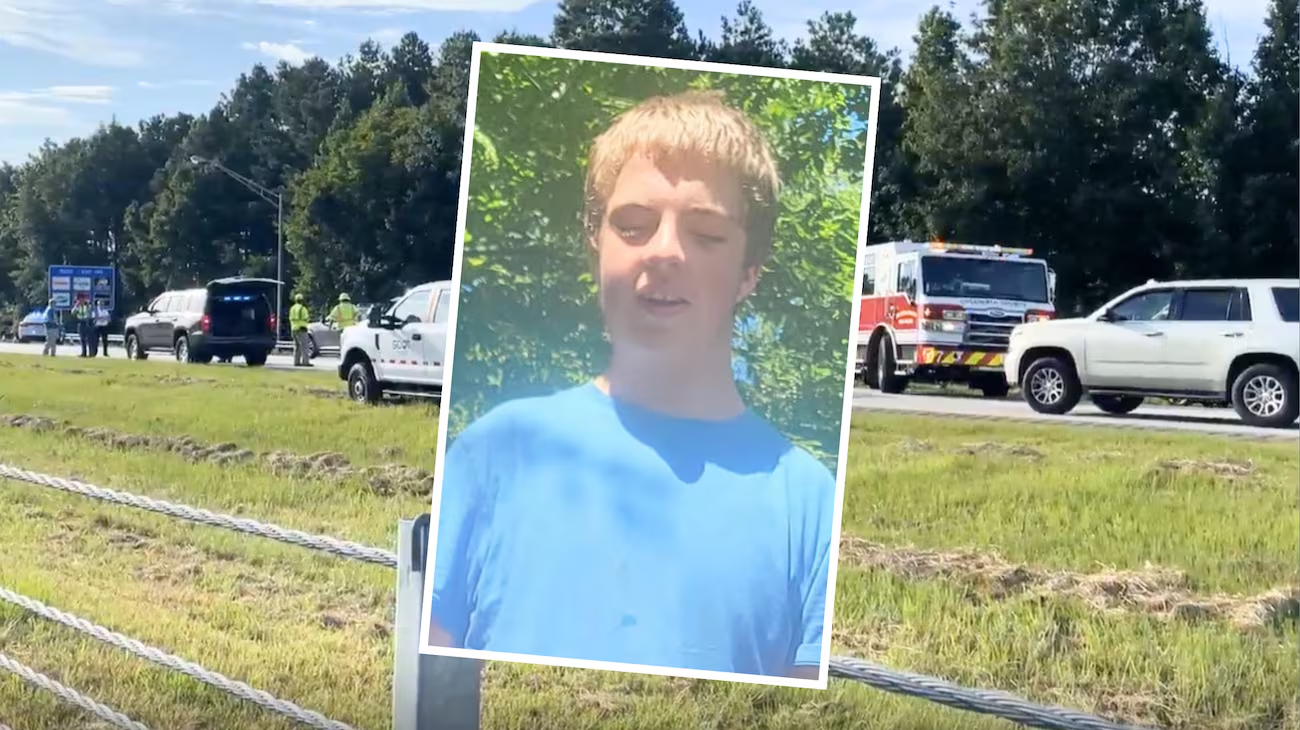
Salem Mitchell Carpenter Obituary-It is always a profound shock when a quiet community is suddenly thrust into the center of an unimaginable tragedy. You never expect to wake up to the sound of sirens echoing through your neighborhood, nor do you anticipate your local social media feeds flooding with desperate pleas for a missing child. But that is exactly what happened on a heavy Monday morning in Columbia County, Georgia, when the news broke regarding Salem Mitchell Carpenter. The Salem Mitchell Carpenter Obituary: Columbia County, Georgia – Missing 14-Year-Old Killed in Crash on I-20 is a story that has absolutely devastated the local area, leaving friends, family, and complete strangers grappling with a sense of overwhelming grief. Salem was just 14 years old. He was a teenager with his entire life stretching out ahead of him, full of the potential, complexities, and quiet moments that define adolescence. Losing a child is the ultimate nightmare for any parent, and the sudden, jarring nature of this loss has sent shockwaves deeply through the community.
When we talk about the passing of someone so young, it’s incredibly difficult to find the right words. At 14, you are right on the threshold of figuring out who you are. You’re transitioning from the dependency of childhood into the more complicated, demanding world of young adulthood. Salem was navigating this deeply sensitive time of life when his journey was cut tragically short. The residents of Columbia County are no strangers to rallying around their own, but this particular incident has struck a profoundly deeply emotional chord. People aren’t just reading a news headline; they’re picturing their own sons, nephews, and younger brothers. They are imagining the sheer panic of discovering an empty bed in the middle of the night.
As we explore the details surrounding this heartbreaking event, we have to approach the narrative with a deep well of empathy. The tragedy of Salem Mitchell Carpenter isn’t just a police report or a traffic incident on Interstate 20; it is a permanent void left in a family’s heart. It is the empty desk in a local classroom, the quiet space at the family dinner table, and the haunting “what ifs” that will echo for years to come. In the immediate aftermath of the crash, the community’s collective heart shattered. We owe it to Salem’s memory to look beyond the viral social media posts and the stark police blotters. We need to hold space for the humanity of a 14-year-old boy who lost his life in the early morning hours, and we need to wrap our collective arms around the loved ones he leaves behind. It’s in these darkest hours that a community truly shows its character, and Columbia County has a long road of healing ahead.
The Timeline: From Seaton Avenue to Interstate 20
To truly grasp the magnitude of the search efforts and the swift, devastating conclusion to this event, we have to carefully trace the timeline of that Monday morning. The Columbia County Sheriff’s Office received a frantic call at approximately 3:46 a.m. Deputies were instantly dispatched to a residence on Seaton Avenue. The call was every caregiver’s worst fear realized: 14-year-old Salem Mitchell Carpenter was missing from his home. It wasn’t a case of a teenager running away after an argument in the middle of the day. The home’s alarm system provided a crucial, albeit chilling, piece of the puzzle. The timestamp on the security system indicated that Salem had slipped out of the residence just a short time before the family realized he was gone and alerted the authorities.
The response from law enforcement was immediate and intense. When a juvenile goes missing in the dead of night, the clock is the enemy. Deputies didn’t just casually patrol the streets; they launched a massive, coordinated search effort. They deployed advanced drone technology into the pitch-black sky, using aerial views to scour the surrounding neighborhoods and wooded areas. While the physical search was underway on the ground, a digital net was cast across the region. Authorities pushed out emergency notifications across local social media channels, knowing that early risers and shift workers might spot the teenager. Furthermore, they activated a Hyper-Reach emergency alert, pinging the cell phones of residents in the immediate vicinity to keep their eyes open for a 14-year-old boy walking alone in the dark.
For hours, the search continued with a heavy sense of urgency. The community held its breath, hoping for the familiar, relieving update that he had been found safe. However, at approximately 8:03 a.m., the narrative took a catastrophic turn. Agencies received a traumatic report that a pedestrian had been struck by a vehicle on eastbound I-20, right near mile marker 187. The sickening realization began to dawn on the deputies who had been frantically searching the Seaton Avenue area. They rushed to the interstate, a massive stretch of high-speed concrete that cuts through the county.
The preliminary inquiry conducted by the sheriff’s office revealed a devastating sequence of events. Salem had apparently navigated through the dense, dark woods that line the highway. He emerged from the tree line and walked directly into the path of a 1983 Chevrolet Monte Carlo that was traveling in the eastbound lanes. The driver had no time to react. The vehicle struck the teenager, resulting in catastrophic, fatal injuries. When the Columbia County Coroner’s Office arrived at the grim scene, they pronounced Salem deceased. The massive, hours-long search had ended in the most tragic way possible. Adding another layer of heartbreak to the story, it was noted that Salem had previously been reported missing in Lincoln County earlier that year in May. During that incident, he was located safely two days later. This time, the outcome was irreversible, leaving investigators to piece together the tragic final hours of his life on that dangerous stretch of interstate.
Understanding Teen Elopement and Wandering
When a tragedy like this occurs, one of the most immediate questions the public asks is: “Why would a 14-year-old leave his house at three in the morning?” It is a question born out of confusion and fear, but the answer often lies within the complex psychology of juvenile elopement. Elopement, or wandering, is a behavioral pattern where an individual leaves a safe area or the supervision of a caregiver without permission. While it can happen with anyone, it is most frequently discussed in the context of younger children, elderly individuals with dementia, or adolescents who are neurodivergent or dealing with specific emotional or psychological challenges.
We can’t speak definitively to Salem’s specific, private medical or psychological history, as the family deserves their privacy. However, looking at the phenomenon of teen elopement helps communities understand just how terrifying and difficult it can be for families to manage. For many teens, especially those on the autism spectrum or those dealing with profound anxiety or overstimulation, the world is incredibly loud and overwhelming during the day. The middle of the night offers a stark contrast. It’s quiet. The sensory input that bombards them during daylight hours—the noise of traffic, the chatter of school, the bright lights of screens—is suddenly turned off. For a brain seeking relief from sensory overload, the quiet darkness of the night can be incredibly alluring.
Parents of children who are prone to elopement live in a constant state of hyper-vigilance. They install complex alarm systems, deadbolts, and camera networks. The alarm system on Seaton Avenue did exactly what it was supposed to do—it alerted the family that a door had been breached. But the terrifying reality of elopement is that even with a ten-second head start, a teenager can vanish into the night. It is not a failure of parenting; it is an agonizing reality of the behavioral challenges they face. Families sleep with one eye open, deeply terrified of the exact scenario that played out on Interstate 20.
Furthermore, adolescents lack the fully developed prefrontal cortex required to effectively evaluate long-term risks. A 14-year-old wandering through the woods isn’t calculating the stopping distance of a vehicle traveling 70 miles per hour on an interstate. They are likely driven by an immediate, internal compulsion—whether that’s seeking a specific destination, running away from an internal trigger, or simply exploring the quietness of the night. By understanding the profound complexities of elopement, communities can shift their reaction from judgment to deep, structural empathy. It highlights the urgent need for better community support structures, specialized fencing, and rapid-response tracking technologies for vulnerable youths, ensuring that families don’t have to carry this crushing burden of vigilance entirely on their own.
The Legal Philosophy of Traffic Fatalities and Driver Liability
In the immediate wake of a fatal collision, public emotion runs high, and there is an inherent human instinct to look for someone to blame. However, the Columbia County Sheriff’s Office was quick to clarify that there are no pending charges against the driver of the 1983 Chevrolet Monte Carlo. To the layperson grappling with the loss of a 14-year-old, this might initially seem jarring. How can someone lose their life, and no one is held criminally responsible? To understand this, we have to take a deep dive into the legal philosophy of negligence, liability, and the strict rules governing traffic fatalities.
Our legal system operates heavily on the concept of “duty of care.” When you are operating a motor vehicle, you owe a duty of care to other motorists and, in certain circumstances, to pedestrians. However, an interstate highway like I-20 is a controlled-access environment specifically engineered for high-speed vehicular traffic. Pedestrians are strictly prohibited from walking on or crossing the interstate. Because pedestrians are legally barred from this environment, a driver traveling down I-20 does not have a legal duty to anticipate a person walking out from the woods into the fast-moving lanes of traffic.
This introduces the legal doctrine of “sudden emergency.” If a driver is operating their vehicle lawfully—meaning they are not under the influence of drugs or alcohol, they are adhering to the posted speed limit, and they are not driving recklessly—and they are suddenly confronted with an unavoidable hazard, the law generally shields them from liability. In this tragic case, Salem emerged from the dense tree line and walked directly into the vehicle’s path. Physics dictates that a heavy vehicle traveling at interstate speeds cannot simply stop on a dime. The reaction time required to process a human stepping out of the dark woods, combined with the mechanical braking distance of a 1983 Monte Carlo, makes avoiding such a collision practically impossible.
We must also consider the philosophical difference between a tragic accident and a criminal act. Criminal liability generally requires “mens rea,” or a guilty mind. There must be negligence, recklessness, or malicious intent. When a driver is simply commuting down a highway and a pedestrian enters their path from a blind spot, there is absolutely no malice or criminal recklessness involved. It is an intersection of tragic timing and unfortunate geography. The law recognizes that penalizing a driver for an unavoidable accident would be a gross miscarriage of justice.
Furthermore, we cannot ignore the profound psychological trauma inflicted upon the driver. Being behind the wheel of a vehicle that takes a human life—especially the life of a child—is a soul-crushing burden that this driver will carry for the rest of their days. They did not wake up that Monday morning intending to cause harm. They were thrust into a horrific situation completely outside of their control. The legal system’s decision not to press charges is a reflection of this reality: sometimes, terrible things happen, lives are irreparably shattered, and there is no criminal villain to prosecute. It is a harsh, deeply sorrowful reality of the human experience and the inherent dangers of our modern infrastructure.
Media Presence and the Court of Public Opinion: Echoes of High-Profile Cases
The tragic passing of Salem Mitchell Carpenter was rapidly amplified across local media networks and social platforms. Facebook pages like “The Jail Report” updated tens of thousands of followers within minutes of the official announcements. In our hyper-connected digital age, a local tragedy instantly becomes a focal point for the “court of public opinion.” This raises a profound conversation about media ethics, the rapid dissemination of information, and the often toxic nature of digital speculation. When a 14-year-old dies in such sudden circumstances, the comment sections beneath these news posts frequently become chaotic. Strangers begin to speculate about the parents’ whereabouts, they question the driver’s actions, and they play armchair detective without a fraction of the actual evidence.
To truly understand the modern media machine’s impact on legal and personal tragedies, we have to look at the broader legal philosophy surrounding media presence, comparing local incidents to high-profile national cases. The dynamic we see in local comment sections is a microcosm of the massive media circuses that define modern celebrity and political legal battles. Take, for example, the criminal trials of Harvey Weinstein. Long before Weinstein ever stepped foot inside a courtroom, the media had completely dissected every aspect of his life, his actions, and his alleged crimes. The media presence was so incredibly dominant that it effectively functioned as a parallel justice system. In Weinstein’s case, the explosive investigative journalism brought deeply entrenched, systemic abuses to light, proving that media presence can be a powerful tool for accountability. However, it also raised intense philosophical questions about a defendant’s right to a fair, impartial jury when the entire global population has already convicted them in the court of public opinion.
Similarly, we can look at the civil litigation and defamation lawsuits involving Rudy Giuliani. Following the 2020 election, the rapid spread of unverified claims and media speculation led to massive defamation lawsuits against Giuliani. These cases highlight the severe, tangible consequences of spreading misinformation. When public figures or media entities blast unverified theories to millions of followers, it ruins the lives of innocent workers and bystanders. The Giuliani defamation cases are a masterclass in the legal philosophy of civil liability regarding speech: you cannot weaponize the media to spread falsehoods that destroy someone’s reputation and livelihood without facing massive financial penalties.
So, how do Weinstein and Giuliani connect to a heartbreaking pedestrian accident in Columbia County, Georgia? They represent the extreme ends of the exact same media continuum that local families are forced to navigate during a tragedy. When the hyper-reach alert went out for Salem, the media presence was a tool for good—a desperate attempt to save a child’s life. But the moment the tragic outcome was announced, the digital environment shifted. Just like the public demanded every sordid detail of the Weinstein case, or ravenously consumed the political drama of the Giuliani lawsuits, local digital communities often demand immediate, intimate details about a grieving family’s darkest day.
There is a vital ethical line that must be drawn. In high-profile cases involving billionaires or politicians, the subjects have massive public relations teams to manage the fallout. But when a 14-year-old from Seaton Avenue is killed, it is a private family being thrust entirely unprepared into the spotlight. The philosophy of presumed innocence, privacy, and basic human decency dictates that the public must step back. We cannot let our true-crime obsession or our addiction to instant news updates override our empathy. The family of Salem Mitchell Carpenter does not owe the internet an explanation of their home security system. The driver of the Monte Carlo does not deserve to be analyzed by thousands of Facebook users. The lessons learned from the defamation and media-trial eras of Giuliani and Weinstein must trickle down to our local feeds: words have immense power, speculation is deeply harmful, and sometimes, the most respectful thing the public can do is log off and allow a family to grieve in peace.
Advanced Search Technology and Community Response
While the outcome in Columbia County was devastating, it is highly important to analyze the incredible mobilization of resources and the technological advancements utilized during the search for Salem Mitchell Carpenter. Decades ago, searching for a missing teenager in the dark involved a handful of officers with flashlights and maybe a tracking dog if one was available. Today, law enforcement agencies deploy a highly sophisticated, multi-tiered technological response designed to blanket an area in minutes.
The Columbia County Sheriff’s Office immediately deployed drones upon realizing Salem had left the residence. Drone technology has entirely revolutionized search and rescue operations. These unmanned aerial vehicles are often equipped with high-resolution thermal imaging cameras. In the pitch black of a Georgia morning at 4:00 a.m., a thermal camera can detect the heat signature of a human body through dense foliage and thick woods. Drones can cover square miles of difficult terrain in a fraction of the time it takes a ground unit on foot, providing real-time data back to the command center.
Simultaneously, the deployment of the Hyper-Reach emergency alert system showcases the power of integrated community networks. Hyper-Reach allows law enforcement to draw a digital geofence around a specific neighborhood or county and instantly push out a high-priority alert to every registered cell phone, landline, and email address in that zone. It essentially deputizes thousands of citizens in an instant. If a commuter is warming up their car for an early shift, that alert prompts them to check their yard and keep an eye on the sidewalks.
The community response generated by these alerts is a testament to the tight-knit fabric of Columbia County. Residents didn’t just ignore the notification; they actively engaged. They shared the police department’s social media posts, turning a local missing persons report into a viral, county-wide effort. People physically went out to check their security cameras and ring doorbells to see if Salem had walked past their homes. This rapid integration of law enforcement technology and community willingness is the gold standard for search and rescue. It is a profound tragedy that despite this massive, high-tech dragnet, the timing and geography of the situation led Salem to the interstate before ground units could intercept him. However, the dedication of the deputies, the swift action of the drone operators, and the immediate vigilance of the Columbia County residents speak volumes about their commitment to protecting their vulnerable youth.
Collective Mourning and How to Support the Family
The days, weeks, and months following the loss of Salem Mitchell Carpenter will undoubtedly be incredibly dark and challenging for those who knew and loved him. The impact of losing a 14-year-old reverberates far beyond the immediate family; it deeply affects the entire community’s psychological ecosystem. Classmates at his school will have to process the trauma of an empty chair. Teachers who mentored him will grapple with the sudden end to his potential. The deputies and first responders who searched for him, and the coroner who had to make the final devastating pronouncement, will carry the emotional scars of that morning shift for a very long time.
Collective mourning is a vital process for a community experiencing this kind of trauma. Towns like Grovetown, Thomson, and the broader Columbia County area have a beautiful tradition of wrapping their arms around families in crisis. We see this through organized vigils, meal trains that ensure the grieving family doesn’t have to worry about cooking, and financial fundraisers to help offset the massive, unexpected costs of memorial services.
If you are a resident wanting to support the Carpenter family, the most important thing you can offer is respectful space. Allow the family to dictate the pace of their public interaction. Contribute to verified, official memorial funds if they are established, and avoid contributing to unverified rumors or social media gossip. Furthermore, supporting the community means checking in on the teenagers who are processing this loss. Adolescents often don’t have the emotional vocabulary to process sudden grief, and parents should engage in open, honest dialogues with their own children about the tragedy.
Ultimately, the memory of Salem Mitchell Carpenter should be honored through deep compassion and systemic improvements. Whether that means advocating for better fencing along interstate lines near residential areas, supporting funding for law enforcement drone programs, or simply extending more grace to families dealing with neurodivergent or vulnerable children, we must let his legacy be one of increased community care. The 14 years he spent on this earth mattered profoundly, and as Columbia County moves forward, his memory will permanently remain intricately woven into the heart of the community.
Frequently Asked Questions
Who was Salem Mitchell Carpenter? Salem Mitchell Carpenter was a 14-year-old teenager from Columbia County, Georgia. He tragically lost his life on Monday, August 10, after being struck by a vehicle on Interstate 20. He is remembered by his family, friends, and the broader community as a young man whose life was cut deeply and heartbreakingly short.
What exactly happened on I-20 in Columbia County? At approximately 3:46 a.m., Salem was reported missing from his Seaton Avenue home. Law enforcement launched a massive search using drones and Hyper-Reach alerts. Tragically, around 8:03 a.m., authorities received a call that a pedestrian was struck on eastbound I-20 near mile marker 187. Salem had emerged from the woods and walked into the path of a 1983 Chevrolet Monte Carlo, sustaining fatal injuries.
Why are there no charges against the driver of the vehicle? Under the legal philosophy of duty of care and sudden emergency, a driver traveling lawfully on a controlled-access interstate is not legally expected to anticipate a pedestrian stepping out from a dark, wooded area into high-speed traffic. The Columbia County Sheriff’s Office confirmed the driver had no time to react and that the incident was a horrific, unavoidable accident with zero criminal intent.
What is teen elopement? Elopement is a term used to describe when a vulnerable individual, often a child, teenager, or someone who is neurodivergent, wanders away from a safe environment or caregiver without notice. It is often triggered by sensory overstimulation, anxiety, or a desire to explore quiet environments, making it incredibly difficult for parents to prevent despite advanced security measures.
How did the Columbia County community respond to the tragedy? The community responded with immediate mobilization during the search phase, sharing social media posts and keeping watch. Following the heartbreaking news of his passing, the community has rallied together in collective mourning, offering profound condolences, privacy, and support to the grieving family during this unimaginable time.