Matt McQuillan Death: Former PGA Tour Player Dies Unexpectedly at 45; Canadian Golf Community Mourns
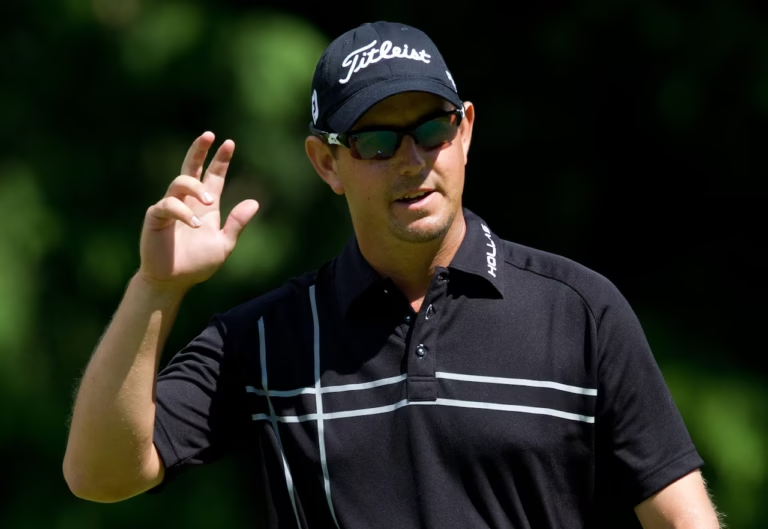
Matt McQuillan Death-You know that feeling when a piece of news stops you dead in your tracks? When you read a headline and instantly have to reread it because your brain simply refuses to process the words? That is exactly what happened when the sports world learned about the Matt McQuillan death. Former PGA Tour player Matt McQuillan passed away unexpectedly at the age of 45 at his home in Kingston, Ontario.
For the Canadian golf community, this is not just the loss of a former professional athlete; it is the tragic, abrupt end of a story defined by incredible resilience, quiet determination, and a love for the game that transcended the standard professional trajectory. When a 45-year-old former professional athlete dies suddenly—especially someone who was known for walking miles of fairways with a healthy, athletic build—it sends a shockwave through their hometown, their national community, and the broader sporting world.
Matt wasn’t just a golfer. He was a son of Kingston. He was a guy who walked away from the sport he loved, carried bags as a caddie to make ends meet, and then authored one of the most unbelievable comeback stories in modern Canadian golf history by earning his PGA Tour card at Q-School. Today, as the Canadian golf community mourns, we owe it to his legacy to take a deep, comprehensive look at his life, his immense impact, the grueling reality of professional golf, and the broader conversations surrounding how we remember our public figures.
The Early Years: Discovering Golf in Kingston, Ontario
To understand the man who would eventually battle against the best golfers in the world on the PGA Tour, you have to travel back to 1991 in Kingston, Ontario. This beautiful city, sitting gracefully where Lake Ontario flows into the St. Lawrence River, has a rich sports history, but it is typically known for producing hockey players, not world-class golfers. Matt McQuillan was about to change that narrative.
Born on June 19, 1981, Matthew Justin McQuillan grew up in a household where sports were a staple. His parents, Mark and Donna, were avid members at the Garrison Golf and Curling Club. Mark was no slouch on the course either—he was a single-figure handicap player who understood the deep, frustrating nuances of the golf swing. He introduced Matt to the game when the boy was just ten years old, inadvertently lighting a spark that would turn into a roaring, lifelong fire.
Roots at the Garrison Golf and Curling Club
The Garrison Golf and Curling Club wasn’t just a place to hit balls for young Matt; it was his second home, his proving ground, and his sanctuary. Anyone who has grown up as a “rink rat” or a “course kid” knows the lifestyle. You get dropped off in the morning with a packed lunch and you don’t leave until the sun dips below the horizon and the pro shop locks its doors.
Under the watchful eyes of pro shop manager John Holland and later, assistant professional Kevin Dickey (who himself had experience on the Canadian Tour), Matt began to hone a swing that was buttery smooth yet violently powerful. He didn’t just learn how to hit the ball; he learned how to play the game. He learned course management, emotional control, and the etiquette that defines the sport. Golf is a profoundly solitary game, and spending thousands of hours alone on the practice green builds a specific type of quiet introspection. For Matt, the fairways of Garrison were where he built the mental fortitude that would later define his career.
Becoming the Youngest Club Champion at Age 15
In golf, the transition from “talented junior” to “legitimate threat” usually happens slowly. For Matt, it happened overnight. In 1996, at the tender age of 15, Matt entered the Garrison Men’s Club Championship. He wasn’t playing against other kids; he was teeing it up against grown men, seasoned amateurs, and veterans of the local golf scene who had been playing the course for decades.
He didn’t just compete; he dominated.
Winning the Garrison Men’s Open and the Club Championship at 15 made him the youngest champion in the club’s history. This wasn’t a fluke. It was a massive localized earthquake that sent a clear message to the Ontario golf establishment: Matt McQuillan is the real deal. Beating adults at a game entirely dependent on emotional regulation and strategic patience requires a level of maturity that most teenagers simply do not possess. This victory was the springboard that launched him onto the provincial and national amateur circuits, eventually catching the eyes of college recruiters south of the border.
Collegiate Trials: The Jump to American College Golf
For a Canadian kid with dreams of the PGA Tour, the traditional path involves securing a scholarship to an American university. The NCAA is the undisputed minor league of professional golf, offering access to elite coaching, year-round warm weather, and a level of competition that simply can’t be replicated in the colder climates of Canada.
Oklahoma State University and the Pressure to Perform
Matt’s exceptional junior career earned him a spot at Oklahoma State University, one of the most prestigious and intimidating college golf programs in the United States. OSU is a factory for professional golfers, boasting alumni like Rickie Fowler, Viktor Hovland, and Charles Howell III. Stepping onto the campus in Stillwater, Oklahoma, is like stepping onto hallowed ground.
But the transition from being the best player in Kingston to being just another elite prospect at a powerhouse program is incredibly jarring. The culture shock of moving from Ontario to the American Midwest, combined with the crushing pressure to perform in qualifiers just to make the starting five for college tournaments, takes a massive toll. At OSU, if you have a bad week, you don’t play. The internal competition is often fiercer than the actual tournaments. Matt learned quickly that raw talent wasn’t enough; you needed an ironclad mental game to survive the collegiate meat grinder.
Transitioning to the University of Georgia
Seeking a better fit for his game and his personal development, Matt eventually transferred to the University of Georgia. The SEC (Southeastern Conference) is arguably the toughest golf conference in the country. At Georgia, playing for the Bulldogs, Matt was surrounded by future tour pros. The courses were longer, the greens were faster, and the margin for error was microscopic.
While his college career didn’t result in national championships, it served as the ultimate crucible. He learned how to travel, how to balance life and golf, and how to compete against guys who were destined for greatness. It hardened him. By the time his collegiate eligibility was up, Matt McQuillan was no longer just a kid with potential; he was a battle-tested player ready to tackle the professional ranks.
Turning Professional: The Grind of the Minor Leagues
In 2003, Matt took the plunge and turned professional. It is the dream of millions of golfers, but the reality of professional golf outside the PGA Tour is profoundly unglamorous. There are no private jets, no multi-million dollar endorsement deals, and no courtesy cars waiting at the airport.
Life on the Canadian Tour
Matt cut his teeth on the Canadian Tour (which later became PGA Tour Canada). Life on this tour is a grueling test of logistics, finances, and sheer willpower. Players drive thousands of miles across the sprawling Canadian landscape, sleeping in budget motels, sharing rooms with competitors to split costs, and eating fast food. You are playing for small purses where a missed cut means you are actually losing money for the week.
This environment weeds out the weak. You either love the game enough to suffer for it, or you quit and get a real estate license. Matt loved the game. He possessed a beautiful swing, but more importantly, he had the grit required to grind through cold mornings in Victoria and windy afternoons in Nova Scotia. He was learning how to shoot 68 when he didn’t have his best stuff, which is the hallmark of a true professional.
The Breakthrough: Winning the 2005 Telus Edmonton Open
The validation for all those miles driven and all those lonely hours on the range came in 2005. Matt captured the Telus Edmonton Open, his first and only victory on the Canadian Tour. Winning a professional golf tournament is exceptionally difficult. You have to put together four consecutive days of brilliant shot-making, excellent putting, and absolute mental clarity.
Lifting that trophy in Edmonton was supposed to be the launching pad. It proved he could win. It proved he had the game to close out a tournament on Sunday under immense pressure. But golf is a fickle mistress. A win doesn’t guarantee future success; it just buys you a little more time to chase the dream. Despite the victory, the subsequent years were filled with inconsistency. The pressure of trying to take the next step—graduating to the Nationwide Tour (now Korn Ferry Tour) or the PGA Tour—began to weigh heavily on his shoulders.
The Wilderness Years: Stepping Away and Finding Perspective
By the late 2000s, the grind had taken its toll. The financial strain, combined with the intense frustration of not breaking through to the highest level, led Matt to make one of the most difficult decisions an athlete can make: he stepped away from playing competitive golf.
From Player to Caddie
When you have dedicated your entire existence to hitting a little white ball into a hole, walking away leaves a massive void. But Matt needed a break from the pressure cooker. To stay close to the game and make a living, he took up caddying.
There is something profoundly humbling about being a caddie when you know you have the talent to be the guy hitting the shots. You are carrying another man’s bag, raking his bunkers, reading his putts, and getting a front-row seat to his successes and failures. But for Matt, this period was not a punishment; it was an education.
Watching other professionals navigate the course allowed him to view the game objectively, stripped of his own emotional baggage. He saw how the best players handled adversity, how they managed their way around the course without firing at every pin, and how they stayed emotionally flat whether they made an eagle or a double-bogey. This time away from the spotlight healed his burnout. It rekindled his love for the game. He wasn’t playing for his livelihood anymore; he was just observing. And in that observation, he found his own game again.
Rebuilding the Swing and the Mindset
Slowly, quietly, the itch returned. Working on his game with zero pressure, Matt began to realize that his physical tools had never left him, but his mental approach had entirely transformed. He was older, wiser, and possessed a deeply grounded perspective. Golf was no longer life and death; it was just a game. Armed with this newfound mental freedom, Matt decided to give the dream one more shot. In 2010, he entered the most terrifying gauntlet in professional sports: PGA Tour Qualifying School.
The Miracle Comeback: Conquering the 2010 PGA Tour Q-School
If you don’t follow golf closely, it is hard to overstate just how brutal the old PGA Tour Q-School was. It was a multi-stage, months-long tournament where thousands of the best golfers on the planet paid exorbitant entry fees for a tiny handful of PGA Tour cards. It was a meat grinder that destroyed careers, ruined finances, and broke spirits.
The Brutal Reality of Qualifying School
Players often refer to Q-School as the most pressure-packed golf they will ever play—more stressful than the back nine of a major championship. In a major, you are playing for a trophy and legacy. At Q-School, you are playing for your job, your mortgage, and your family’s future. One bad bounce, one lipped-out putt, or one errant tee shot over six grueling rounds can mean the difference between playing against Tiger Woods on national television or going back to the mini-tours to play for pennies.
Securing the Tour Card on the First Attempt
Matt McQuillan entered the 2010 Q-School with no status, flying completely under the radar. He advanced through the grueling first and second stages, a monumental achievement in its own right. But the Finals—a six-day, 108-hole marathon held in Orlando, Florida—was the ultimate test.
Against all odds, the former caddie from Kingston played the golf of his life. He navigated the pressure with the calm demeanor he had learned while carrying other people’s bags. On his first attempt at the final stage, Matt secured his PGA Tour playing privileges for the 2011 season. It was a Cinderella story. The Canadian golf media erupted. Matt McQuillan had achieved the impossible, transforming from a burned-out ex-pro into a fully fledged member of the PGA Tour.
Rookie Season on the PGA Tour: Playing with the World’s Best
The 2011 PGA Tour season was the culmination of a lifetime of work. Matt was suddenly teeing it up alongside legends of the game at some of the most iconic venues in the world.
Navigating the 2011 Season
Being a rookie on the PGA Tour is incredibly difficult. You are playing courses you have never seen, competing against fields stacked with generational talent, and dealing with the overwhelming logistical circus of the Tour. Matt faced the typical rookie struggles—missed cuts, tough travel schedules, and the constant pressure to earn enough FedEx Cup points to retain his card for the following year.
But he proved he belonged. Over the course of the season, he posted three top-ten finishes. He showed flashes of absolute brilliance, proving that his swing and his mind could hold up under the brightest lights in the sport.
The 2011 John Deere Classic: A Defining Third-Place Finish
The absolute pinnacle of his PGA Tour career came in July 2011 at the John Deere Classic at TPC Deere Run in Silvis, Illinois. This tournament is known for yielding low scores, meaning players have to aggressively hunt birdies to stay in contention.
Over four days, Matt put on a ball-striking clinic. He fired rounds in the 60s, climbing the leaderboard and putting himself in the mix on Sunday afternoon. The pressure of Sunday on the PGA Tour is suffocating. The television cameras are constantly in your face, the galleries are massive, and every shot is scrutinized. Matt didn’t flinch. He finished the tournament tied for third place, just a few strokes behind the winner.
That finish earned him a massive paycheck and invaluable FedEx Cup points, but more importantly, it earned him the respect of his peers. The kid from Kingston had gone toe-to-toe with the best in the world and walked away with a podium finish. It remains one of the most celebrated moments by a Canadian rookie in modern PGA Tour history.
The Unforgiving Nature of Professional Golf
While the highlight reels show the trophies and the made putts, the reality of life as a professional golfer is deeply taxing. Following his rookie season, Matt battled injuries, swing changes, and the relentless pressure to perform, eventually losing his full-time status on the Tour.
The Physical Toll of the Sport
People often underestimate the physical toll of golf. The modern golf swing is a violent, highly unnatural twisting of the human spine. Hitting thousands of golf balls a week, year after year, destroys backs, wrists, and elbows. For players like Matt, staying healthy is just as important as making putts. The travel schedule—sleeping in different hotel beds every week, flying across time zones, and walking upwards of 30 miles a week on the course—ages the body rapidly.
Mental Health and Financial Pressures on the Fringe of the Tour
The mental health aspect of professional golf is perhaps its most brutal feature. Unlike team sports where you still get paid your guaranteed contract if you ride the bench or have a bad game, professional golfers are independent contractors. If you don’t make the cut, you don’t get paid. Period. You actually lose money because you still have to pay your caddie, your travel, and your lodging.
This creates a state of perpetual anxiety. Every putt is tied to a dollar amount. Living on the fringe of the Tour, battling to get back through Monday qualifiers or Korn Ferry Tour events, is a psychologically exhausting existence that tests the very limits of human endurance. Matt navigated these waters with characteristic quiet dignity, eventually transitioning out of competitive touring to focus on life back home in Canada.
Media Presence, Public Scrutiny, and the Legal Philosophy of Privacy
When exploring the life, career, and sudden passing of a public figure like Matt McQuillan, it opens a broader, deeply important conversation about media presence, public scrutiny, and the legal philosophy surrounding the right to privacy.
In today’s hyper-connected, digital-first society, the media presence of a public figure is a double-edged sword. We consume their triumphs and tragedies with an insatiable appetite. However, legal philosophy often dictates that individuals who voluntarily enter the public eye—be they politicians, actors, or professional athletes—forfeit certain expectations of privacy.
The Contrast Between Sports Heroes and Scandal-Ridden Figures
We see this legal philosophy vividly applied in high-profile legal battles and scandals. When notable cases involve deeply controversial figures—take, for instance, the intense, relentless media circuses surrounding Harvey Weinstein or the legal unraveling of Rudy Giuliani—the media landscape transforms into an aggressive, adversarial microscope. The legal philosophy and journalistic ethics surrounding these notable cases argue that the public has a fundamental right to know. The walls of privacy are completely torn down. In these instances, the media presence is invasive, fundamentally altering how we consume the downfall of highly scrutinized individuals. The public sphere demands total transparency, often stripping these figures of any personal sanctuary.
But when we pivot from the dark, scandal-driven corridors of legal downfalls to the sudden, tragic death of a beloved sports figure like Matt McQuillan, the media paradigm fundamentally shifts. McQuillan was a public figure, yes. His name was in newspapers, his scores were broadcast on television, and his achievements were public record. But his public persona was built on quiet determination, athletic excellence, and sportsmanship—not controversy.
The Right to Privacy During Sudden Tragedies
When the news broke that the 45-year-old former PGA Tour player died unexpectedly, the media and the public faced a different philosophical question: How do we balance the public’s desire for information with the family’s fundamental right to privacy during a time of immense, shocking grief?
Unlike the Weinstein or Giuliani spectacles where public interest overrides personal privacy, the death of a respected athlete calls for a journalistic retreat. Reports emerged that Matt suffered a sudden heart attack, but his family rightfully requested strict privacy. The legal philosophy here leans heavily back toward the individual. The public’s “right to know” ends where a grieving family’s trauma begins. The Canadian golf media handled his passing with immense grace, choosing to celebrate his life, his 2011 Q-School miracle, and his John Deere Classic finish, rather than prying into the intimate details of his sudden death. It is a profound reminder that behind every public figure, behind every athlete we cheer for on Sunday afternoons, there is a human being with a family that deserves the dignity of private mourning.
The Sudden Passing: Navigating the Shock of a Tragic Loss at 45
The news of the Matt McQuillan death surfaced in early August 2026. He passed away on August 5 (with some public tributes appearing on August 7), at just 45 years old.
The Events of August 2026
When word spread through the tight-knit Kingston community and the sprawling Canadian golf landscape, the immediate reaction was sheer disbelief. Forty-five is exceptionally young. It is an age where former athletes are supposed to be settling into the second act of their lives, perhaps coaching, playing senior amateur events, or simply enjoying the peace of family life away from the relentless grind of the Tour.
He died unexpectedly at his home in Kingston, surrounded by the town that built him. While official family statements focused on preserving his memory rather than medical specifics, reports trickled through the golf community that he succumbed to a sudden heart attack.
Processing the Suddenness of Heart-Related Passings in Athletes
There is a specific kind of psychological trauma associated with the sudden death of an athlete. We view professional athletes—even former ones—as paragons of physical health. They have spent their lives optimizing their bodies, walking thousands of miles, and exercising rigorously. When someone like Matt McQuillan is taken by a sudden cardiovascular event, it shatters our illusion of invincibility. It forces everyone in the community to confront their own mortality. It is a stark, terrifying reminder that genetics and sudden medical events do not care about how well you strike a 7-iron or how many miles you’ve walked on the treadmill.
How the Canadian Golf Community Mourns a Local Legend
The response to Matt’s passing was immediate and deeply emotional. The Canadian golf community is relatively small compared to the American juggernaut; everyone knows everyone. From the junior circuits in Ontario to the top executives at Golf Canada, the loss was felt profoundly.
Tributes from Golf Canada and the PGA Tour
Official statements poured in from Golf Canada and the PGA Tour, acknowledging not just his playing record, but his character. He was remembered as a man of quiet resilience, a player who never demanded the spotlight but earned it through sheer grit. The PGA Tour released statements highlighting his incredible journey from caddie to Tour member, ensuring that his legacy would be permanently etched in the annals of golf history.
A Wave of Support from Fellow Canadian Professionals
Social media became a digital memorial. Fellow Canadian professionals, many of whom are currently carrying the torch on the PGA Tour—players like Nick Taylor, Corey Conners, and Adam Hadwin—understand exactly how hard it is to achieve what Matt did. They understand the Canadian Tour grind. They understand the terror of Q-School. Their tributes highlighted his perseverance, calling him an inspiration to anyone who had ever considered giving up on their dreams.
Locally, friends and former competitors from the Garrison Golf and Curling Club shared stories not of Matt the PGA Tour player, but of “Matty,” the kind, approachable guy who always had time to give a quick swing tip to a struggling junior or share a beer after a Tuesday evening men’s league round.
The Broader Impact on the Kingston Community and Local Charities
Beyond the fairways of the PGA Tour, Matt’s impact was deeply local. Kingston is a community that fiercely supports its own. For decades, Kingston has hosted massive charity events, such as the Syl Apps Charity golf tournament, which raised immense funds for the local Rotary Club and featured celebrities like the late NHL star Dennis Hull.
Matt was part of this fabric. Having a local guy reach the PGA Tour elevated the entire Kingston sports scene. It gave local kids a tangible hero. When junior golfers at Garrison or Cataraqui Golf and Country Club hit balls on the range, they weren’t just dreaming of being Tiger Woods; they were dreaming of being Matt McQuillan, because Matt proved that you could make it to the biggest stage in the world right from their very own hometown.
His passing leaves a massive hole in the local sports community, but it also sparks a desire to preserve his memory. Discussions of memorial tournaments, junior scholarships in his name, and permanent tributes at the Garrison Club are the natural next steps for a city looking to honor one of its greatest athletic exports.
The Enduring Legacy of Matt McQuillan in Canadian Sports
When we look back at the life and career of Matt McQuillan, what is the ultimate takeaway? It isn’t just the 2005 Edmonton Open victory. It isn’t just the miraculous 2010 Q-School run, or even the brilliant third-place finish at the 2011 John Deere Classic.
His legacy is the embodiment of resilience. In a sport that actively tries to break your spirit on a daily basis, Matt refused to stay down. He showed an entire generation of Canadian golfers that it is okay to step away, to regroup, and to find yourself before attacking your dreams again. He proved that the path to success doesn’t have to be linear. You can go from child prodigy to struggling pro, to bag-carrying caddie, to PGA Tour star.
Matt McQuillan’s death at 45 is an undeniable tragedy that robbed his family and friends of decades of memories. But the 45 years he lived were packed with more triumph, adversity, and spectacular achievement than most people could accomplish in a dozen lifetimes. As the Canadian golf community mourns, they do so with a profound sense of gratitude that they got to watch him play, watch him fight, and watch him soar.
Frequently Asked Questions (FAQs) About Matt McQuillan
Who was Matt McQuillan? Matt McQuillan was a Canadian professional golfer from Kingston, Ontario, who played on the Canadian Tour and the PGA Tour. He is best known for his incredible comeback story, transitioning from a caddie back to a player and earning his PGA Tour card in 2010.
When did Matt McQuillan die? Matt McQuillan passed away unexpectedly on August 5, 2026. The news of his death was widely reported and mourned by the golf community in the days following his passing.
What was the cause of Matt McQuillan’s death? While the family has rightfully requested privacy regarding the specific medical details, widespread reports indicate that he suffered a sudden and unexpected heart attack at his home in Kingston.
How old was Matt McQuillan when he died? He was 45 years old. He was born on June 19, 1981, making his sudden passing deeply shocking to the sports world.
What was his best finish on the PGA Tour? His career highlight on the PGA Tour came during his rookie season in 2011, where he secured a brilliant tie for third place at the John Deere Classic.
Did Matt McQuillan win any professional tournaments? Yes. He won the 2005 Telus Edmonton Open on the Canadian Tour (now PGA Tour Canada), a major milestone in his early professional career.
What is PGA Tour Q-School? Qualifying School (Q-School) was an intense, multi-stage annual tournament where professional golfers competed for a limited number of spots on the PGA Tour. Matt famously passed through all stages and secured his card on his first attempt at the finals in 2010.
Where did Matt McQuillan go to college? He began his collegiate golf career at the powerhouse program of Oklahoma State University before transferring to the University of Georgia to complete his collegiate eligibility.
Where did he grow up playing golf? He grew up playing at the Garrison Golf and Curling Club in his hometown of Kingston, Ontario, where he famously became the youngest club champion in history at the age of 15.
How is the Canadian golf community honoring him? Fellow professionals, Golf Canada, and the PGA Tour have released statements honoring his resilience and character. The local Kingston community and his home club are expected to organize memorial tributes to ensure his legacy inspires future generations of junior golfers.